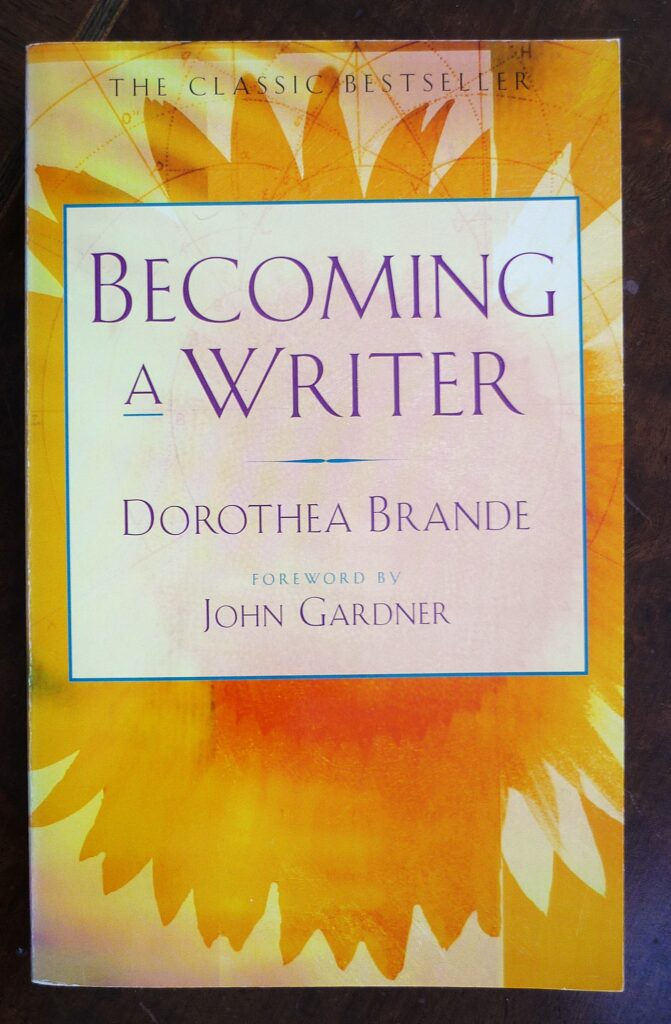
Sometimes it pays to go back to basics. I wouldn’t say Becoming a Writer is the Bible for fiction writers – more like the Dead Sea Scrolls. But it is invaluable. Read it.
Becoming a Writer by Dorothea Brande was first published in 1934, when typewriters were the order of the day and manuscripts were sent off with stamped, addressed envelopes for return.
But Dorothea hit on something in this early book that has been copied and developed and turned into a self-help creative writing industry. This book is the original and in some ways still the best.
Her tone is perhaps a bit sharp for modern tastes, and her travels into psychology are of their time. One can almost hear Dorothea instructing her students – and taking no nonsense from any of them. But her advice about letting the writing come from a place where the editing part of the writer is ‘turned off’ (and how to achieve that) is perfect. I’m pretty sure she is the inventor of the famous Morning Pages which have become the staple of many writers and which were championed by Julia Cameron in her The Artist’s Way amongst others. I don’t know of any earlier versions of this advice. She’s also strong (insistent!) on the need to write regularly, increase your output gradually and not wait for inspiration to strike.
This short book (180 pp.) has had a tremendous on more recent, particularly American, writers like Julia Cameron and Peter Elbow in his Writing Without Teachers.
Becoming a Writer has remained in print since 1934. It’s defiinitely worth a read. It might even help you start that novel or short story – or shift you out of the stubborn writing block.
‘The unconscious is shy, elusive, and unwieldy, but it is possible to learn to tap it at will, and even direct it. The conscious mind is meddlesome, opinionated, and arrogant, but it can be made subservient to the inborn talent through training.‘
Becoming a Writer
Dorothea Brande